
The individual stickers fit the design brief. The finished sheet does not fit the retail sleeve. Reducing the artwork to solve the problem would also shrink the small functional stickers that were already approved. The missing dimension was the outside of the backing, not the size of the printed illustrations.
For custom sticker sheet size, approve the whole delivered carrier and its receiving space before filling the layout. Keep the backing outline, individual sticker cutlines and printed area separate. Then review how the complete sheet is packed, displayed and handled. A good-looking collage cannot establish those boundaries.
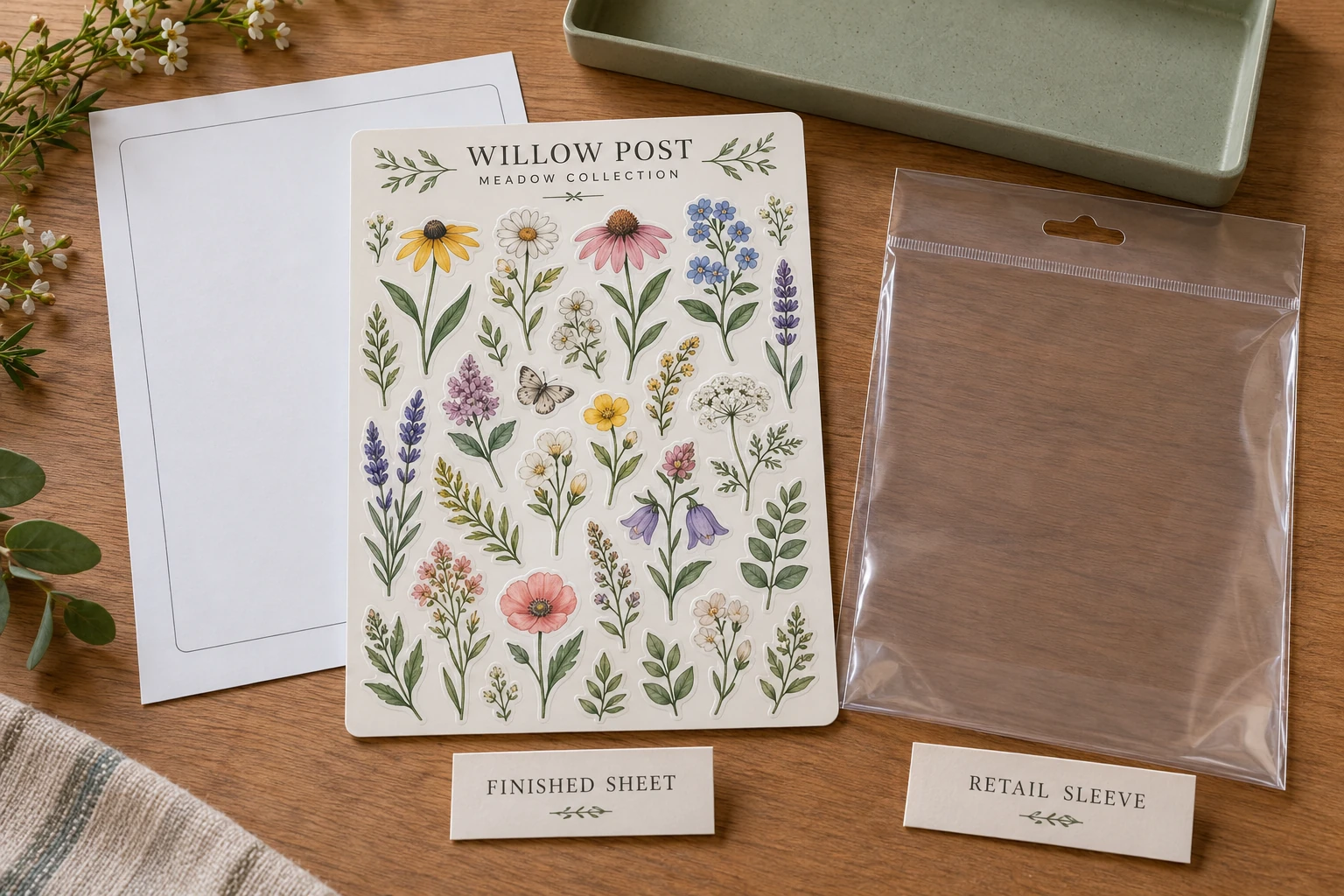
Name all three boundaries on the brief
Record the finished backing width and height with units and orientation. Identify the removable shapes within it, and distinguish the artwork or printing boundary from both. If the sheet includes a branded header or information that remains on the backing, show that area as a deliberate part of the product.
Do not ask for an “A5-style” or “small” sheet when an actual outer size is needed. A familiar format can be a starting proposal, but the supplier and buyer still need the exact agreed drawing. Likewise, the largest sticker's dimensions do not identify the backing that will arrive around it.
Use the custom sticker sheet page to establish the supply route, then obtain a drawing for the actual quoted product. Do not borrow another service's available sizes or spacing advice as ZC Labels' tolerances, sheet options or minimum gaps. Those details need confirmation for the proposed order.
Start from the sleeve or other receiving space
If the complete sheet goes into a sleeve, backing card system, parcel insert or display, identify that receiving item and its version. Review the usable space rather than copying a nominal outside dimension from its product name. Include the opening, closure, header and any other part that affects insertion or presentation.
| Boundary or object | Decision it needs to support |
|---|---|
| Finished backing outline | What complete sheet is delivered |
| Sticker cutlines | What pieces the user removes |
| Printed header or margin | What stays visible on the backing |
| Sleeve or receiving item | Whether the whole delivered sheet fits its intended route |
| Packed set | How several sheets and other components interact |
Where fit matters, ask for a representative physical reference. A scaled photograph can help explain a concept, but it cannot confirm insertion clearance or the condition of corners after handling. Agree the relevant observation and acceptance owner without inventing a universal clearance.
Keep sticker scale intact while changing the carrier
If the proposed backing must become smaller, do not automatically scale every sticker down. Identify which elements have a functional minimum determined by actual use: a writing box, a product name or a piece intended to cover a particular area. Review those elements at final size before changing their layout.
A rearrangement, fewer repeats, another sheet or a different receiving package may be worth comparing. Each changes the product differently. A second sheet may preserve sticker size but changes the number of delivered sheets and the pack contents. A larger sleeve may preserve the layout but changes the packing component. The buyer needs to approve that consequence, not just the visual balance.
The planner sheet guide covers the smallest functional sticker, writing and peeling. This article's decision is the complete carrier envelope and its fit with the intended receiving object. Use the two records together when both constraints matter.
Ask the converter to review the whole layout
Show the individual cutlines, backing perimeter and required retained areas in one controlled file. Ask the supplier which layout details need adjustment for the proposed construction and process. Do not transfer another service's gap or edge margin into the order as a universal rule.
Keep peel access visible. Increasing the design count may make a crowded sheet harder to use even when the printed shapes technically fit. A branded edge can also serve a handling purpose, but it should not be assumed to solve every peeling problem. Review a representative converted sheet when the decision depends on actual handling.
If the supplier proposes trimming or supplying smaller grouped sheets, confirm the new finished unit. What looks like an efficient production change may alter the retail product, counting basis and packing instructions. A production sheet is not automatically the same object as the complete sheet the customer expects to receive.
Count the finished sheets and the pack separately
Write the quantity of complete sheets by approved layout. If several sheets form one set, identify the set contents and its quantity in a separate field. A count of individual illustrations cannot substitute for either number.
For an illustrative botanical collection, a buyer could choose one larger carrier or two smaller carriers holding different pieces. Neither is inherently the same sellable product. Compare artwork coverage, receiving fit, handling and quoted packing scope before comparing the apparent sheet price.
The finished-format comparison explains how sheets differ from loose die-cut and individual kiss-cut pieces. Once a sheet is selected, preserve its actual outer outline rather than allowing the format name to carry the entire specification.
Approve the received state, then preserve it
Retain the final backing drawing, cutline version, artwork reference and receiving-package identification together. Check the sheet as supplied and as placed into the agreed sleeve or set. If a component changes later, identify which fit or handling observation needs repeating instead of treating unchanged sticker artwork as a complete reorder approval.
Record the whole sheet's flatness in its supplied and use states
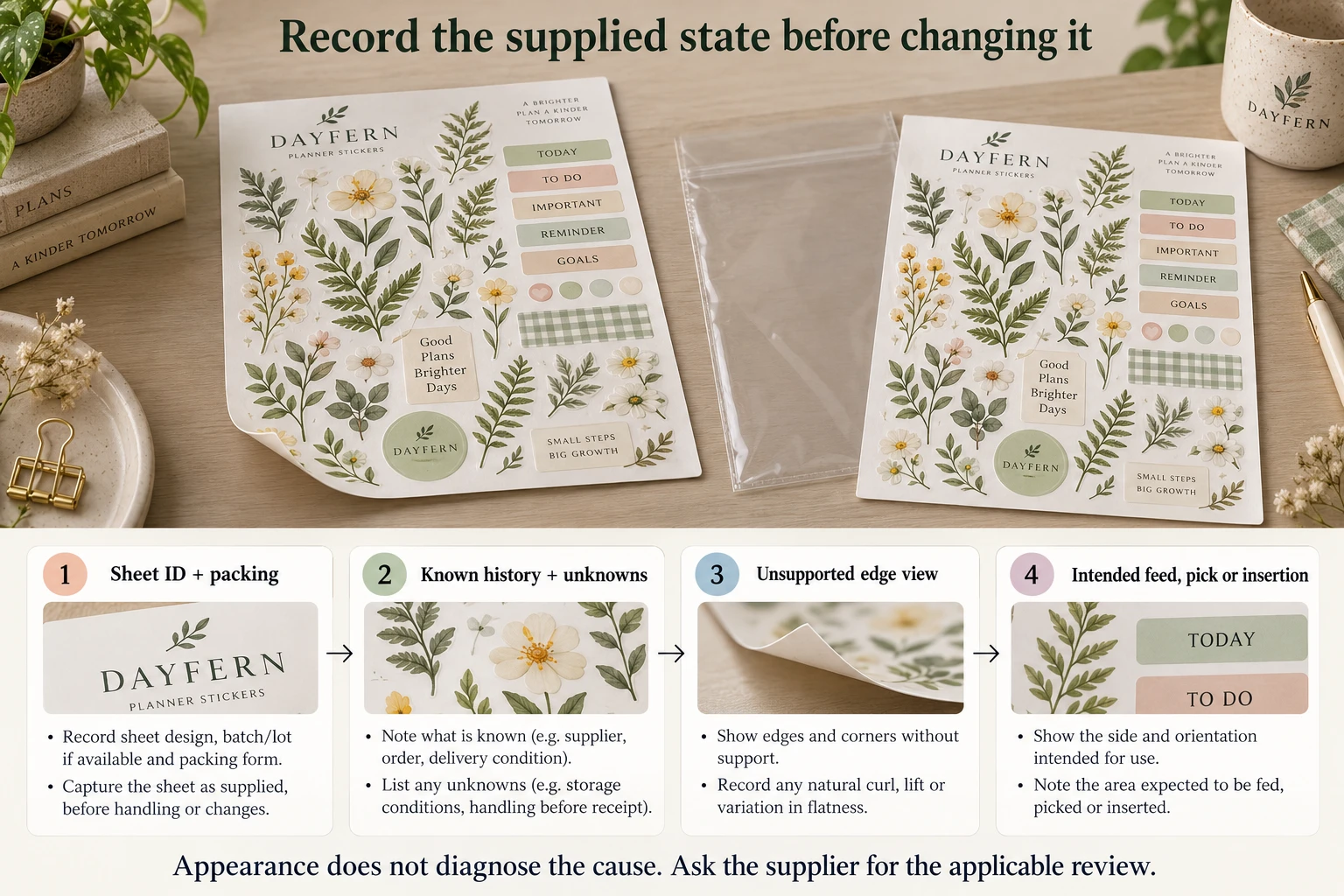
The backing dimensions can be correct while a sheet arrives or is presented in a state that causes another handling question. Keep the size drawing unchanged while documenting that observation. A curled corner is not evidence that the artwork should be scaled down, and a sheet pressed flat for a photograph is not evidence that the normal supplied state is suitable.
Identify the sheet, construction, packing and observation stage. Record whether it has just been removed from protective packing, rested under the supplier's instructions or passed through another operation. Where the history is uncertain, retain the gap. Do not invent a universal conditioning interval before the supplier has identified the actual construction requirements.
Avery's 5667 storage guidance discusses environmental changes and sheet layflat for that product. It supports asking about the complete material and its history, not declaring a general humidity limit or diagnosing every curl from appearance.
| Whole-sheet record | What it should make clear |
|---|---|
| Identity and complete dimensions | Which supplied unit is being observed? |
| Packing and known history | What state preceded the observation? |
| Unsupported shape or edge view | What happens without being pressed flat? |
| Intended insertion, feed or pick route | Which action is affected? |
| Supplier/owner response | What reference or further check is needed? |
Retain an unaltered sheet when practical, with photographs that show its complete outline and the affected edge. Ask the supplier how to handle and review it. Avoid improvised heating, reverse rolling or forceful flattening as an assumed remedy; those actions can change the evidence the reviewer needs.
For local printing, confirm the equipment's supported sheet and media route separately. For retail insertion, review the real sleeve or receiving item. The same backing dimensions can participate in different tasks, so the approval should name the task and accepted observed state. A revised liner or packing proposal needs confirmation against that state rather than approval based only on a familiar width and height.
Send ZC Labels a whole-sheet size brief with the proposed backing dimensions, actual-size artwork and cutlines, sleeve or display photos and usable-space information, quantities by layout and sheets per set. These inputs support a drawing and packing discussion that protects the functional sticker sizes while making the whole delivered sheet usable.