
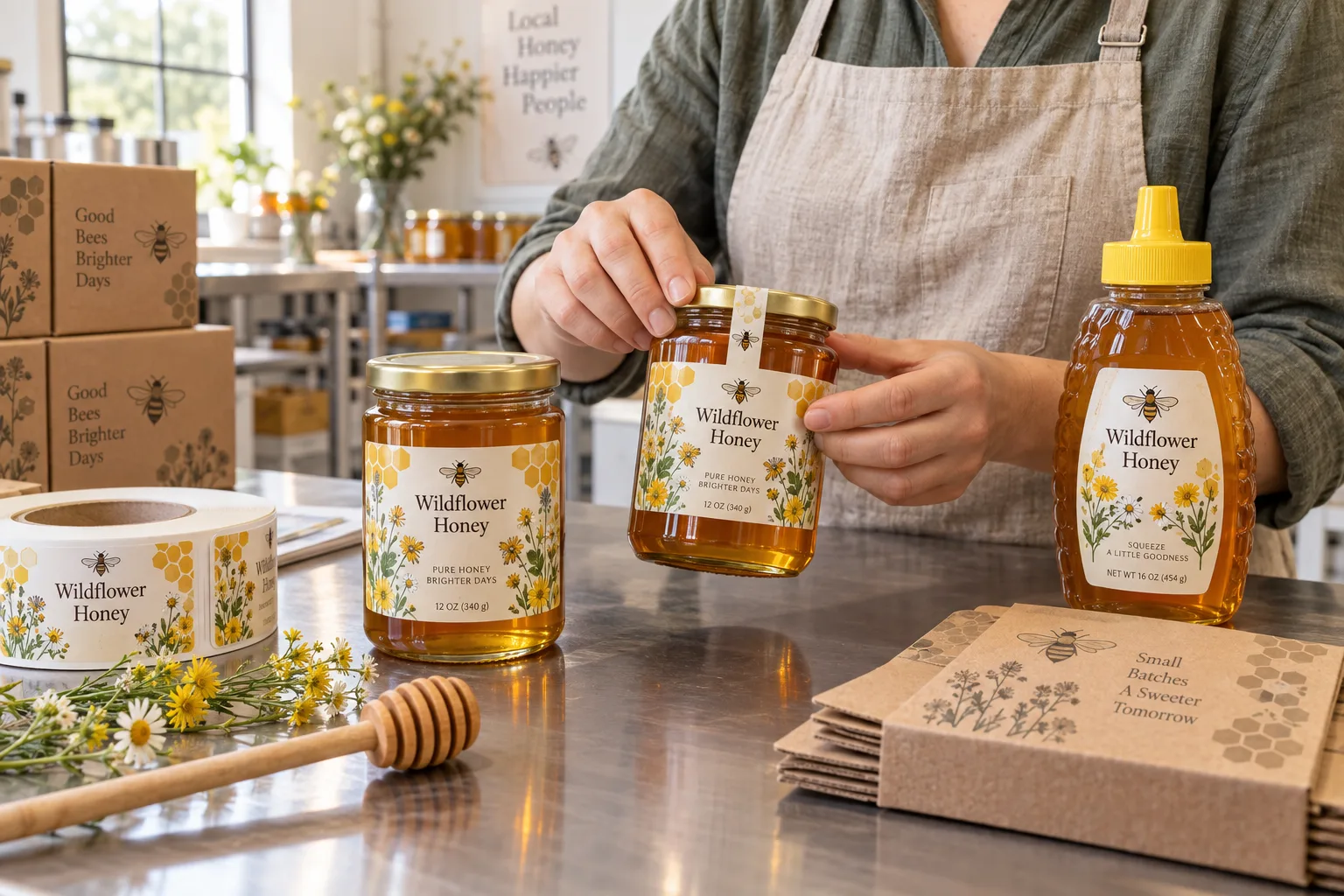
Honey packaging creates an easy visual trap. The amber product looks beautiful, so the artwork grows wider and more decorative until it crosses the curve of the jar. Then the printed label arrives, the edges sit on a radius and the jar begins to decide the design.
On a real packing bench, we start with the container family. A straight glass jar, a shouldered jar and a squeezable bottle may carry the same honey, but they do not offer the same label panel. One artwork system can connect them; one identical label construction may not.
Find the Straight Panel on Every Container
Measure the jar where the label will actually sit. Do not use only the widest circumference. Check the top, middle and bottom of the proposed area. If those measurements change, the panel is tapered and a wide rectangular label may wrinkle or lift.
A squeeze bottle adds movement. Its surface can deform during handling, and a label near a shoulder may repeatedly flex. A shorter front label can sometimes look more controlled than an ambitious wrap. The goal is not to cover the most plastic or glass. It is to create a label that stays intentional after filling and use.
| Package | Main risk | Useful check |
|---|---|---|
| Straight glass jar | Residue, condensation and application alignment | Cleanliness and consistent front panel |
| Tapered jar | Wrinkles and edge lift | Circumference at several heights |
| Squeeze bottle | Flexing and small curved panel | Filled squeeze test with final label |
| Lid seal | Two surfaces and an opening fold | Lid coating, jar neck and evidence goal |
Sticky Handling Changes Surface Preparation
Honey does not need to pour over the label to affect the job. A small residue on a jar, a worker's glove or the packing table can reduce adhesive contact. Labels should be applied to clean, dry containers before the package becomes difficult to handle.
If jars are washed, chilled or warmed during production, describe that sequence. Condensation and temperature differences matter at the moment of application. Testing a dry room-temperature display jar is not enough when the real line applies labels under different conditions.
Use Illustration to Organize Varieties, Not to Hide Information
Honey labels can carry real visual character without borrowed mascots or empty white placeholders. Original wildflowers, honeycomb structures, regional plants and simple bee icons can identify varieties while keeping the brand system coherent. The artwork should earn its space, not push essential information into unreadable corners.
For several floral sources or jar sizes, decide what remains fixed and what changes. A controlled illustration panel and color accent are easier to manage than rebuilding the whole label for every variety. This also reduces the chance that the wrong front and back files are paired during a reorder.
Decide What the Lid Seal Is Supposed to Prove
A strip from lid to jar can be decorative, can discourage casual opening or can be designed to show visible disturbance. Those are not identical promises. A paper strip may tear clearly but respond poorly to moisture. A stronger film may survive handling yet remove too cleanly from a particular lid coating.
Describe the desired opening evidence, then test the seal across both surfaces. The adhesive meets metal or plastic on the lid and glass or plastic on the container. The fold over the edge is a third stress point. If a regulated tamper-evident feature is required, confirm the applicable market rules and packaging responsibility with qualified specialists rather than relying on a generic sticker claim.
A Practical Honey Label Test
- Use containers from the intended supplier and production lot
- Measure the proposed panel at the top, middle and bottom
- Apply labels before honey residue reaches the outside
- Check alignment and edge contact after filling and packing
- Test wiping, refrigeration or condensation when relevant
- Squeeze flexible bottles repeatedly and inspect the label
- Open lid seals and record the visible result
- Keep one approved package for artwork and reorder control
What We Would Put in the Quote Request
Send container photos and samples, label-panel dimensions, lid material, artwork, quantities by variety and size, finish preference, application method and packing needs. List front labels, back labels and lid seals as separate components even when they share artwork.
The jar should not become a blank canvas that ignores physics. Give it original flowers, honeycomb, color and personality, but let the curve, handling and opening method set the boundaries first.