
The buyer enters a quantity by design. The quotation mentions a production quantity condition that the buyer overlooks. Receiving later counts the stock against the request, while accounts compares it with the invoice. Three correct documents can still describe different expectations if nobody agreed what the delivered count must mean.
For bulk sticker orders, confirm the finished counting unit and any proposed quantity variation before release. Keep the supplier's actual terms beside each design allocation. Do not assume a universal overrun allowance, an exact-count service or a standard payment rule. The point is to expose the proposed agreement while it can still be discussed.

Start with the unit that will be received
Name complete sheets, individual backed pieces, finished packs or another agreed unit. A sheet containing several removable designs is still one delivered sheet when that is the product being purchased. A bag holding several pieces has a separate contents definition. Do not reconcile artwork shapes against pack counts without the conversion being explicit.
Put the quantity beside each design or layout. A correct grand total can conceal a short allocation of the design the buyer actually needs. If every finished retail pack requires several identified pieces, confirm the available quantities support the intended assortment rather than merely adding up to enough loose stickers.
The finished-format guide distinguishes these physical units. Here the purchasing task is to decide what quantity obligation applies to those units and how an actual delivery will be reconciled against it.
Ask what the supplier is proposing
Request a clear response about whether the quoted quantity is exact, subject to a stated condition or otherwise qualified. If a variation is proposed, ask how it applies by artwork and delivered unit, how it is reported and how any commercial treatment is determined. Retain the actual answer; do not insert a familiar percentage from another supplier.
If the buyer needs a particular usable quantity for a launch, set assembly or packing appointment, state that requirement. The supplier must confirm feasibility and quoted scope. An internal requirement becomes a supplier commitment only when the parties actually agree it.
Likewise, do not assume extra pieces are automatically free, desirable or interchangeable across designs. A surplus of one variant cannot necessarily make a complete pack that is short of another. The agreed counting basis and terms need to determine the comparison.
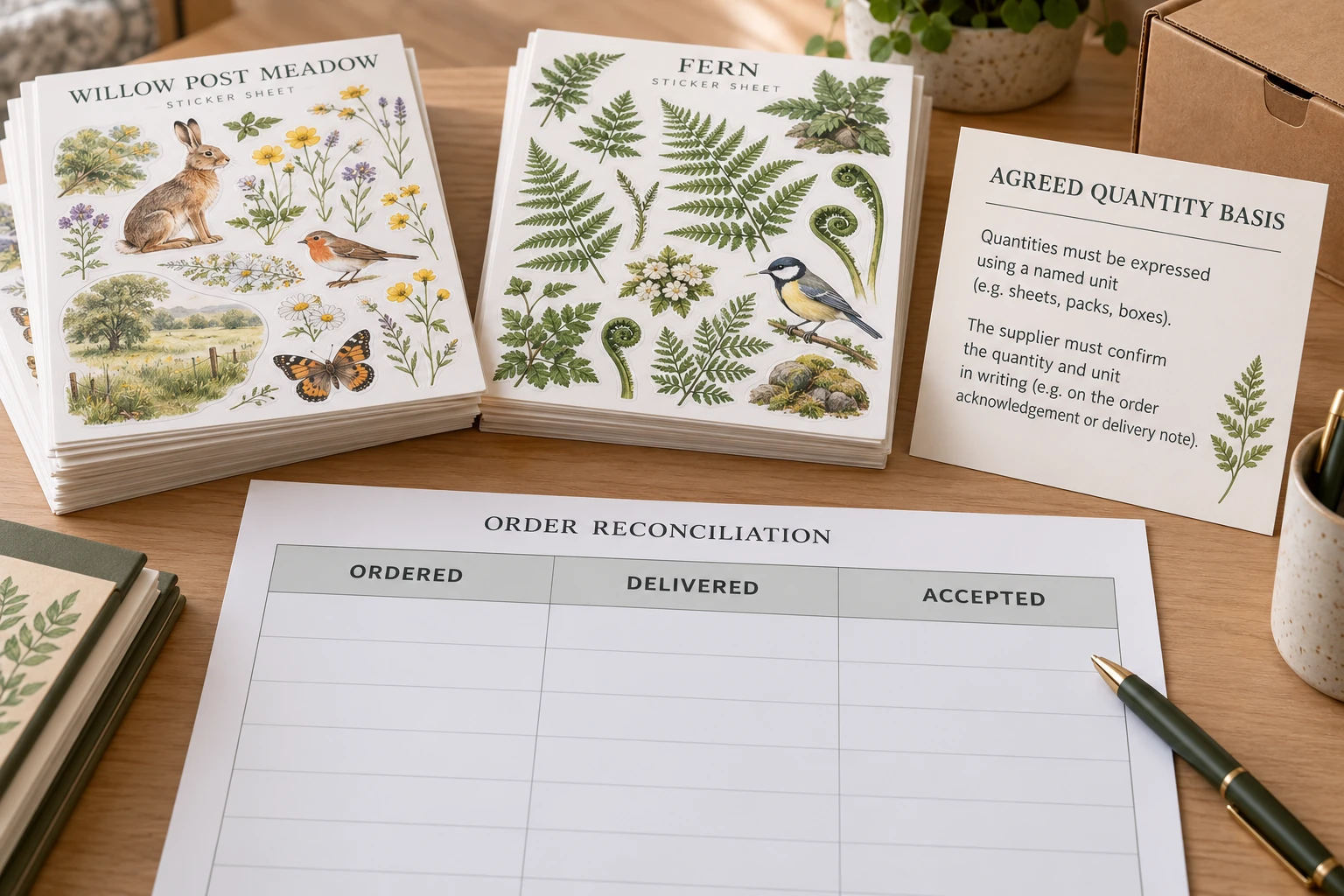
Keep four quantities from becoming one number
| Quantity field | Meaning to agree |
|---|---|
| Requested | What the buyer asks to purchase, by named unit and design |
| Confirmed basis | What the accepted quotation or order specifies |
| Delivered | What the supplier reports and receiving observes |
| Accepted for use | What the responsible owner accepts under the agreed requirements |
These fields may contain the same number, but they should not be treated as synonyms before the checks are complete. A delivered piece may be the wrong design or subject to an unresolved product issue. A completed invoice does not itself prove an actual accepted count.
Record how pieces affected by a known production exception are treated. For controlled identifiers or other sequence-dependent work, retain the relevant data reconciliation requirements separately. Do not assume that enough physical labels establish a correct set of identifiers.
Make a pack-dependent order explicit
Consider an illustrative set containing one meadow sticker and one fern sticker. An equal total number of pieces across both designs is not enough information to establish the number of complete sets. The buyer needs the count of each required component and the approved assembly scope.
If one design may arrive under a proposed quantity condition, ask how that condition affects finished sets. The answer might require a different agreed arrangement, another production proposal or a changed packing plan. Do not let the factory or warehouse infer the buyer's priority after stock has arrived.
For sheet-based products, state the layout reference and number of complete sheets per set. Do not count individual motifs as if they were loose items when the entire sheet is sold or used as one product. The denominator in the quantity record should match the product the recipient expects.
Give receiving a comparison it can perform
Send the confirmed design quantities and units to the receiving owner in the same revision as the order. Identify what information should accompany the cartons or rolls and how discrepancies should be recorded. Ask for feasible identification rather than inventing a supplier's tracking system.
The bulk receiving guide covers checking the delivered design mix. Use it against the confirmed quantity basis, rather than an earlier enquiry that was later revised. Preserve the actual count method and any uncertainty about the observed extent.
If a discrepancy arises, retain the affected stock identification and relevant records for the responsible parties. This article does not establish claim deadlines, replacement rights or how every invoice must be settled. Those decisions depend on the accepted terms and the actual issue.
Close the gap before comparing prices
A low unit amount can describe a different quantity obligation or packing scope. Compare the same finished unit, artwork allocation and agreed delivery basis before deciding which quotation serves the project. Do not silently convert an uncertain field into zero cost or guaranteed supply.
Use the custom sticker sheet route where complete sheets are the required unit. Send the artwork/layout references, requested quantities by design, units per set, required usable quantity and any exact-count concern in a quantity-basis enquiry. Those inputs let the supplier respond to the actual obligation instead of leaving receiving and accounts to interpret it later.